
A dining elevator, also known as a food delivery elevator, is mainly used to transport meals in the catering industry. Many users believe that this type of elevator does not carry passengers, has a small load capacity, and is slow, so there is no risk of accidents. Therefore, it does not fall into the category of special equipment and does not require a certificate of qualification.
Although the "small dining elevator" cannot carry people, it is a type of service elevator and is a special equipment. Its production, installation, procurement and use must comply with the relevant provisions of the Special Equipment Safety Law.
Utility elevators can generally be divided into two types: floor-standing type (trolley type) and sill type (window type).
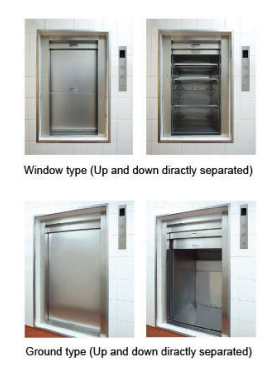
Ground type: This type of utility elevator can be directly leveled with the ground. Users can choose different sizes of elevator cars according to their own needs. Users can put trolleys or dining carts directly into the elevator car.
Window type: This type of utility elevator is leveled at a certain height from the ground to form a working platform, which is at the level of the operator's waist. It is suitable for users to transport small and light items. It has flexible forms and can be used in a variety of occasions.
Standardize the use and management of service elevators
1. Standardize installation registration. The user unit shall purchase and use the utility elevator that has obtained the license for production and passed the inspection, entrust the qualified installation unit to inform and install before the construction, handle the use registration in time, and obtain the use registration certificate. The installation unit shall not install or install illegal utility elevators without qualification.
2. Standardize daily use. Carry out supervision and regular inspection as required, sign a maintenance contract with a qualified unit for regular maintenance; establish special equipment related ledgers and safety technical files; conduct regular inspections every day, and stop using it immediately if any abnormality is found, and it can only be put into use after the hidden dangers are completely eliminated; purchase elevator insurance.
3. Strengthen personnel training. Provide necessary safety warning education and operation skills training for safety management personnel and operators. Strengthen employee safety education and training, formulate emergency rescue measures and emergency rescue plans for elevator safety accidents and conduct regular drills to prevent irregular operations such as stacking debris in front of the elevator and entering the elevator with the head.
4. Standardize regular inspections. In accordance with the requirements of safety technical specifications, regular inspection requirements should be submitted to the special equipment inspection agency one month before the expiration of the validity period of the elevator inspection. Equipment that has not been inspected within the prescribed period or has failed the inspection must not be used.
[Company news]Customer Feedback | Stability Test by Our Client
[Company news] Project Update | Thanks to JM LIFT
[Company news]20 Days to Go | Guangzhou Elevator Expo
[Tech-Blog]Procedure for Static Brake Force Testing of Synchronous Elevator Traction Machines
[Company news]Project Delivered | Five-Star Hotel Elevator in Tanzania
·Customer Feedback | Stability Test by Our Client
· Project Update | Thanks to JM LIFT
·20 Days to Go | Guangzhou Elevator Expo
·Procedure for Static Brake Force Testing of Synchronous Elevator Traction Machines
·Project Delivered | Five-Star Hotel Elevator in Tanzania
·Precautions for the Overspeed Governor and Safety Gear Linkage Test
·Exhibition Invitation | Meet FUJI Precision in Guangzhou
·From Visit to Trust | Partnership with FUJI Precision
·FUJI Precision Elevator UCMP Protection Function Test Procedure
Contact Us
× English
 Pусский
 Español
 بالعربية
 Français