
You are here: Home » News » Tech-Blog » Self-learning method of NICE3000new host
Self-learning method of NICE3000new host
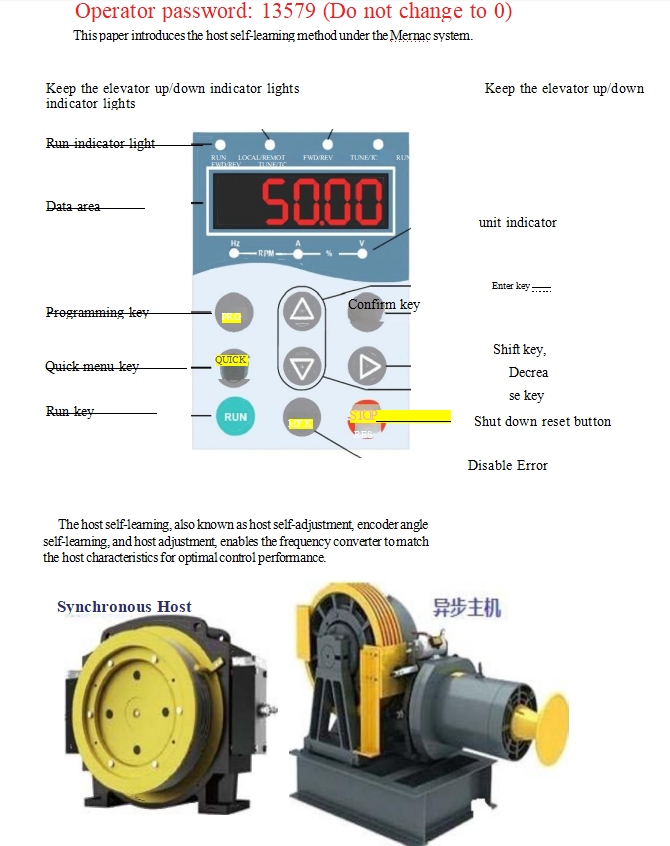
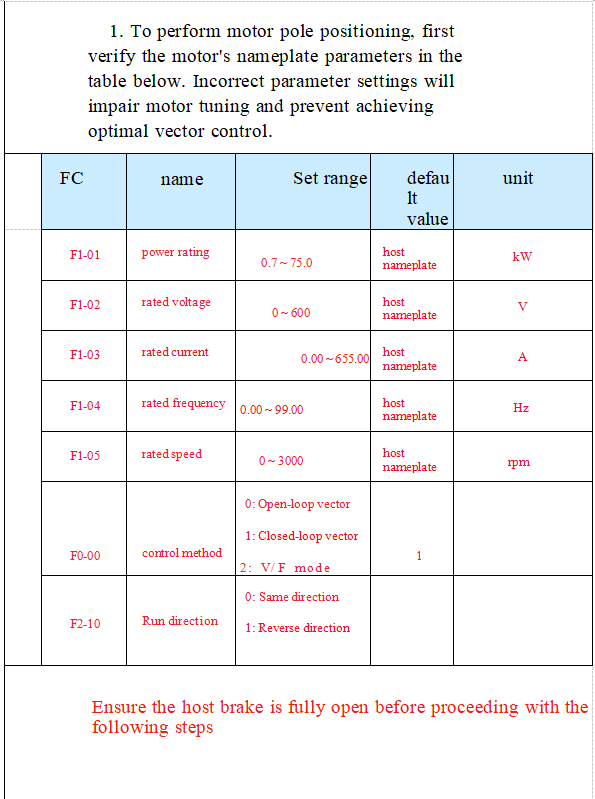
Synchronous Host Self-learning Method
Set the elevator to maintenance mode. Specify the encoder type and pulse.
F1-00=0 、F1-12=2048 、F1-25=1
1. No-load Tuning Method (Main Unit Without Steel Wire Rope)
1) After configuring the parameters above, set F0-01 to 0 and press the STOP reset button on the operator to clear the fault (the small screen will not display E52 or E51 faults).
2) Set F1-11 to 2. The small screen will display TUNE.
3) Hold the brake contactor BY in place, press the green RUN button at the lower right corner of the control panel. The motor will emit a 'clunk' sound, then rotate for about 10 seconds before automatically stopping. The motor will complete its self-learning process. Release the brake contactor.
4) Upon completion of the learning process, F1-06 will be the motor angle. Perform the motor learning procedure at least three times as described above, ensuring the error margin does not exceed 5°. After finishing the learning, set F0-01 to 1.
5) If the phase sequence is incorrect, report E20 fault subcode 3. Simply swap the U and V phases of the output line and restart the host's self-learning process.
6) Change the running direction F2-10
2. Load-tuned Method (with the main unit already connected to the steel wire rope)
1) After configuring the above parameters, perform a power cycle to clear the fault (the small screen displays E52; E51 fault does not affect tuning).
2) Set FO-01=1 and F1-11=1, then press and hold the maintenance up/down button. The motor will emit a 'clunk' sound and automatically stop after approximately ten seconds. The F1-06 value indicates the motor's angle. Perform at least three motor calibration cycles with an error margin of no more than 5°. If the motor runs in the opposite direction to the button, adjust F2-10.
3) If the phase sequence is incorrect, report E20 fault subcode 3. Simply swap the U and V phases of the output line and restart the host's self-learning process.
4) Change the running direction F2-10
Asynchronous machine host learning method
Set the elevator to maintenance mode. Specify the encoder type and pulse.
F1-00=2 、F1-12=1024 、F1-25=0
1) After configuring the above parameters, perform a power cycle to clear the fault (the small screen displays E52; E51 fault does not affect tuning).
2) Set F0-01 to 0 and press the reset button STOP on the controller to clear the fault. Set F1-11 to 1. The small screen will then display TUNE.
Press the green RUN button at the lower left corner of the controller to initiate static motor tuning. After the motor completes self-learning and resets to F0-01=1, it can be tested and run for maintenance.
3) If the phase sequence is incorrect, report E20 fault subcode 3. Simply swap the U and V phases of the output line and restart the host's self-learning process.
4) When the E20 fault subcode 12 is detected, swap the A and B phases of the encoder wires and restart the host's self-learning process.
5) Change the running direction F2-10
[Company news]Customer Feedback | Stability Test by Our Client
[Company news] Project Update | Thanks to JM LIFT
[Company news]20 Days to Go | Guangzhou Elevator Expo
[Tech-Blog]Procedure for Static Brake Force Testing of Synchronous Elevator Traction Machines
[Company news]Project Delivered | Five-Star Hotel Elevator in Tanzania
·Customer Feedback | Stability Test by Our Client
· Project Update | Thanks to JM LIFT
·20 Days to Go | Guangzhou Elevator Expo
·Procedure for Static Brake Force Testing of Synchronous Elevator Traction Machines
·Project Delivered | Five-Star Hotel Elevator in Tanzania
·Precautions for the Overspeed Governor and Safety Gear Linkage Test
·Exhibition Invitation | Meet FUJI Precision in Guangzhou
·From Visit to Trust | Partnership with FUJI Precision
·FUJI Precision Elevator UCMP Protection Function Test Procedure
Contact Us
× English
 Pусский
 Español
 بالعربية
 Français