
I. Purpose The State Administration for Market Regulation issued TSG T7001-2023 "Rules for Supervision and Periodic Inspection of Elevators" on April 6, 2023. Clauses A1.3.4.3 and A1.3.5 of the rules relate to the speed governor and safety gear linkage test. This document explains the precautions for the speed governor and safety gear linkage test.
Standard Text:
A1.3.4.3 Linkage Test
The speed governor-safety gear linkage test shall be conducted under the following conditions to observe whether the speed governor and safety gear operate reliably. After the test, no damage that adversely affects the normal use of the elevator shall occur (replacement of friction parts and glass parts is permitted);
(1) When using an instantaneous safety gear during supervision and inspection. (1) The car is loaded with a load of the rated load capacity and descends at the inspection speed; for elevators using a progressive safety clamp, the car is loaded with a load of 125% of the rated load capacity and descends at the rated speed, or at a lower speed (applicable only to elevators with a rated speed greater than 4.0 m/s) (Note A1-22);
(2) During periodic inspections, the car is empty and descends at the inspection speed.
Note A1-22: For elevators with glass in the car, during supervisory inspections, it is permissible to conduct tests without glass, provided that safety precautions are in place, but a load of equal weight to the glass should be added to the car.
A1.3.5 Counterweight (Balance Weight) Speed Governor-Safety Clamp Test
A1.3.5.1 Speed Governor and Electrical Safety Devices
Check whether the speed governor and its electrical safety devices comply with the requirements of Annex A1.3.4.1 and A1.3.4.2, items (1) to (3). A1.3.5.2 Linkage Test The speed governor-safety gear linkage test (Note A1-23) shall be conducted under the following conditions. The reliability of the speed governor and safety gear operation shall be observed. After the test, no damage adversely affecting the normal use of the elevator shall occur (replacement of friction components is permitted).
(1) During supervision and inspection, if an instantaneous safety gear is used, the car shall be unloaded and ascend at the maintenance speed; if a progressive safety gear is used, the car shall be unloaded and ascend at the rated speed, or at a lower speed (applicable only to elevators with a rated speed greater than 4.0 m/s).
(2) During periodic inspection, the car shall be unloaded and ascend at the maintenance speed.
Note A-23: For safety gears triggered by methods other than the speed governor, the test shall be conducted according to the requirements of the elevator manufacturing (modification) unit.
II. Installation and Debugging
1. Safety Gear Installation: The safety gear is pre-installed on the lower beam connecting plate of the car frame. After installing the car frame, adjust the safety gear fixing bolts and nuts so that they are not overtightened.
2. Clearance Adjustment:
2.1 Adjust the clearance between the brake block and both sides of the guide rail. Adjust the clearance between the wedges or rollers on both sides and both sides of the guide rail to be consistent, with an error within 0.5mm. The clearance on one side is approximately 2.5-3.5mm. The parallelism tolerance between the tooth surface of the wedge and the side of the guide rail is less than 0.5mm, as shown in the lower left figure.
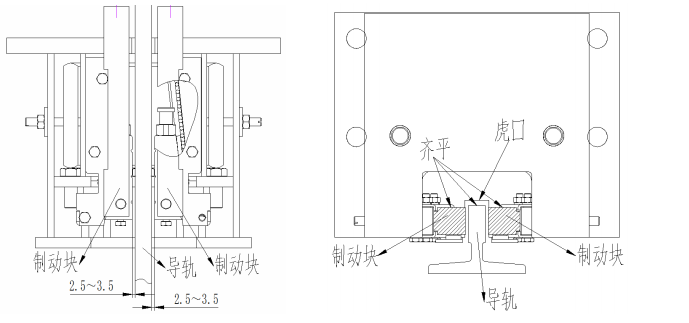
2.2 Adjust the clearance between the brake blocks and the top surface of the guide rail so that the entire braking surfaces of the brake blocks on both sides align perfectly with the guiding surfaces of the rail. The inner surfaces of the brake blocks should be flush with—or protrude slightly beyond—the top surface of the guide rail. At this point, a clearance should remain between the top surface of the guide rail and the jaws of the safety gear (a clearance of 3–5 mm is recommended); refer to the figure on the top right.
2.3 Once the adjustment of the clearances between the safety gear and the sides and top surface of the guide rail is complete, securely tighten the safety gear mounting bolts.
3. Installation of the Lifting Rod:
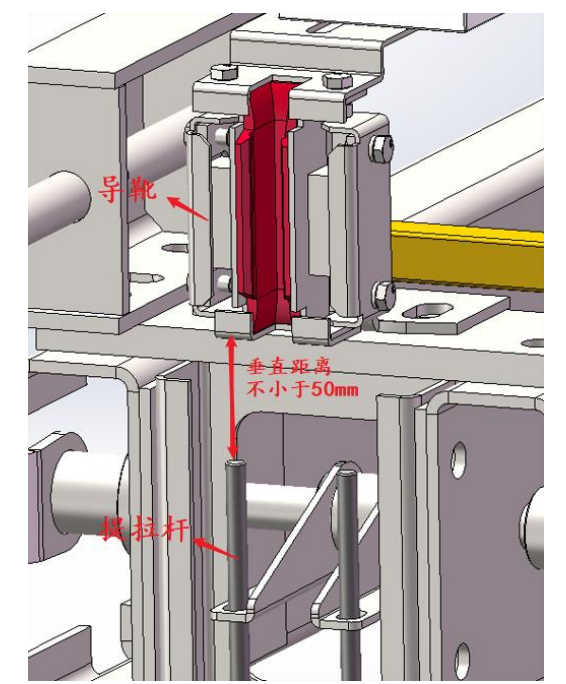
If the unit is equipped with a safety gear lifting rod, screw one end of the rod into the connecting nut on the safety gear lifting plate. Connect the other end of the rod to the corresponding position on the lifting mechanism. Once connected, ensure that the lifting rod remains vertical and does not interfere with the guide rail or the safety gear during the lifting process; also, verify that the effective lifting stroke is maintained. Finally, tighten the securing nut to prevent the lifting rod from loosening during operation.
Under normal elevator operating conditions—when the safety gear is not engaged—a clearance of at least 50 mm must be maintained above the top of the lifting rod to prevent interference with the guide shoes when the rod is actuated.
4. Adjustment of the Downward-Pulling Floating Safety Gear:
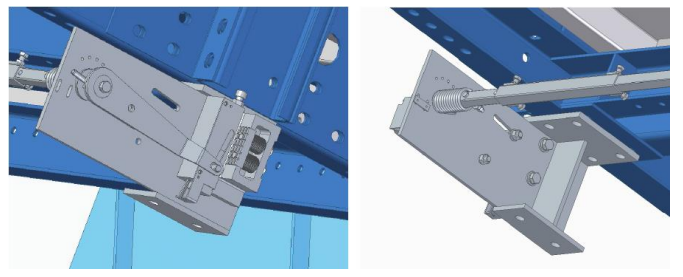
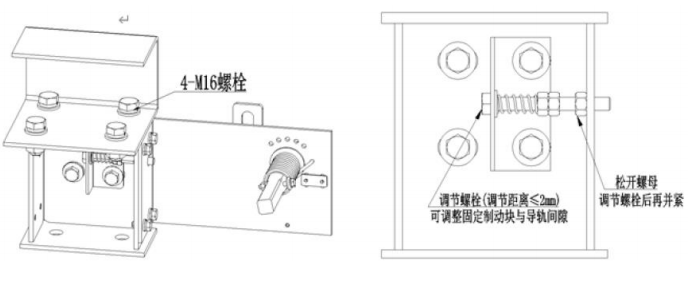
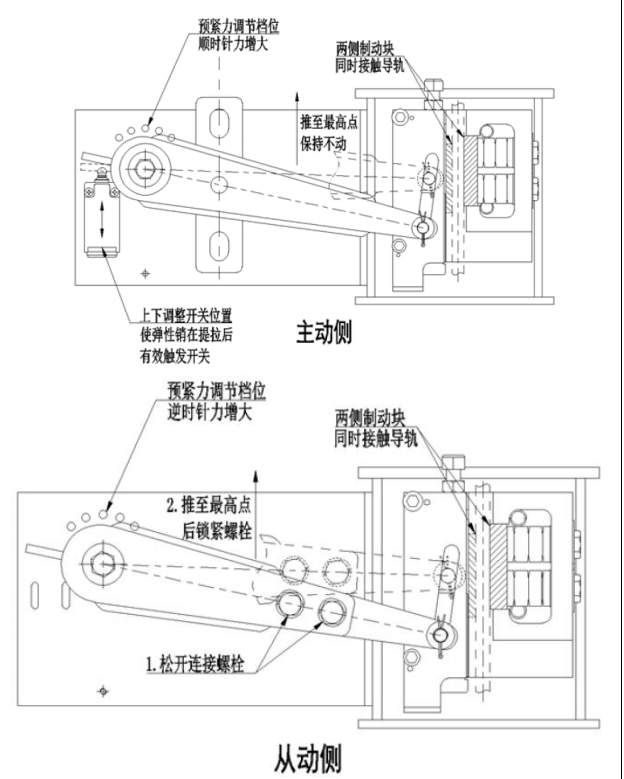
As shown in the figure below, the safety gear bodies are rigidly fixed to the safety gear frame assembly, and the two safety gear units are interconnected via a connecting rod. Mount the left and right pulling components onto their dedicated brackets (or the bottom beam) using M16 bolts. Adjust the lateral positioning of the pulling components to ensure that the clearance between the braking surface of the fixed brake block on each safety gear unit and the guiding surface of the guide rail is uniform and consistent, measuring approximately 2.5 mm. If the desired clearance cannot be achieved through this adjustment, rotate the adjustment bolts to bring the gap into compliance with the specified requirements.
Synchronous Linkage Adjustment:
Push the safety gear pull rod on the active side (the governor side) upward to its highest point. At this stage, the brake blocks on both sides of the active-side safety gear should be in contact with the guide rails.
Due to transmission lag, the brake blocks on the passive-side safety gear will not simultaneously contact the guide rails. Loosen the connecting bolts on the segmented pull rod, push that pull rod upward to its highest point, and then retighten the connecting bolts. Repeatedly lift the active-side pull rod and observe whether the brake blocks on both sides of the safety gear make simultaneous contact with the guide rails; if they do, the adjustment is complete; otherwise, repeat the preceding steps until synchronization is achieved.
4. Synchronous Debugging of the Linkage Mechanism:
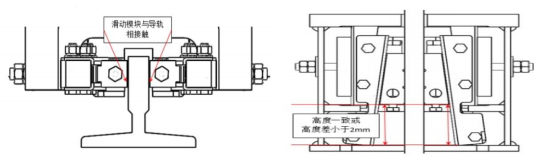
4.1 Have one worker manually pull the speed limiter cable or lifting rod upwards from the lifting rod side of the linkage mechanism (the pulling force should be between 150 and 300 N, measured with a force gauge). The lifting mechanism should cause the brake blocks of the left and right safety clamps to move upwards flexibly without any jamming or obstruction. Simultaneously, another worker should observe whether the brake blocks on both sides of the safety clamp simultaneously contact the guide rail (see lower left figure). This can be done by using a steel ruler to measure whether the height of the two brake blocks is consistent, or by using a long-handled screwdriver to push the brake blocks upwards on both sides separately. The stroke error of the brake blocks that can be pushed up should be <2 mm (see lower right figure). If they contact simultaneously, release the speed limiter cable or lifting rod; the brake blocks of the left and right safety clamps should automatically return to their lowest position.
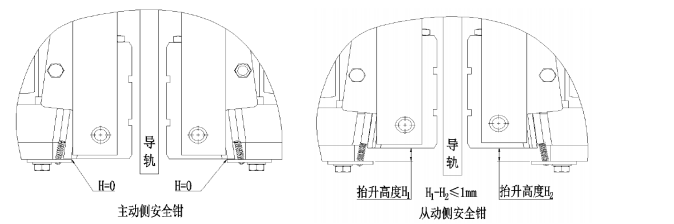
4.2 Due to the lag in the mechanical transmission of the lifting mechanism, if the brake block of the other side (driven side) safety clamp cannot contact the guide rail, the screw of the driven side operating mechanism needs to be adjusted to raise the brake blocks on both sides to an equal height H (see the figure below; H has no fixed value and depends on the on-site adjustment). After raising, lift the driving side safety clamp and observe whether the driven side brake block contacts the guide rail simultaneously. If not, continue to increase the lifting height and repeat the steps until the brake blocks of both the left and right safety clamps contact the guide rail simultaneously. After completing the synchronous lifting, tighten the nut to prevent the lifting screw from loosening, thus achieving synchronous completion of the left and right safety clamps and the linkage mechanism.
5. In the final stage of elevator commissioning, verify the clearance parameters of the safety gear, the linkage performance of the lifting mechanism, and check the tightness of the nuts at each connection point.
III. Speed Limiter Safety Gear Linkage Test Procedure
1. Preparation Stage
1.1 Check the clearance between the traction sheave, each anti-cord sheave, each guide sheave, and the rope stop device. Adjust the distance between the wire rope and the rope stop device to be less than the radius of the traction wire rope.
1.2 Place guardrails at the base station floor entrance and warning signs inside the car to prevent passengers from calling for the elevator during the test.
1.3 Move the car to the top floor level position and confirm that there are no passengers inside.
1.4 If a counterweight safety gear is present, before conducting the 125% load safety gear linkage test, the linkage function between the counterweight speed limiter and the counterweight safety gear must be manually disconnected to avoid the rebound generated during the car safety gear linkage test causing malfunction of the counterweight safety gear.
1.5 Before conducting the counterweight safety gear linkage test, the linkage function between the car speed limiter and the car safety gear must be manually disconnected to avoid the rebound generated during the counterweight safety gear linkage test causing malfunction of the car safety gear.
2. Test Procedure
Note 1: If using an instantaneous safety brake, load the car with 100% of the rated load and descend at maintenance speed.
Note 2: If using a progressive safety brake, before conducting the 125% rated load, rated speed descent test, first test the 100% rated load, maintenance speed descent condition. Then check the safety brake clearance and the car's levelness. After confirming and adjusting correctly, then conduct the 125% rated load, rated speed descent test.
2.1 Use a call command or other means to move the car downwards while keeping the brakes released.
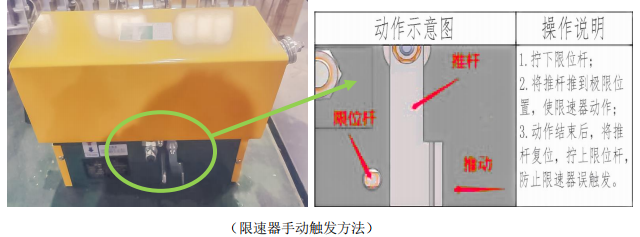
2.2 When the car speed reaches the test speed, immediately manually trigger the speed governor to activate the safety brake. If the speed governor is equipped with a manual trigger device, the method is shown in the diagram below. If the speed governor is equipped with a remote trigger device, it can be operated from the control cabinet.
Note: Other braking devices (functions) can be left unshielded during this process. If any abnormalities or uncertainties occur, the brakes should be engaged immediately.
2.4. Preliminary Post-Test Inspection: After the car stops, the wire rope should not be slack or derailed. If slack or derailment occurs, check if the counterweight safety gear (if any) has malfunctioned; check that the car frame is not significantly deformed or tilted; check that the traction machine frame or crossbeam is not deformed or tilted.
2.5. Mark the car position for easy locating of safety gear braking marks later.
2.6. Reset the control system malfunction.
2.7. Press and hold the maintenance/emergency electric operation button to move the elevator upwards and release the safety gear; if the safety gear cannot be released, use a special tool to pull the car to release the safety gear.
2.8. Reset the speed governor mechanical trigger device, speed governor switch, and safety gear switch.
IV. Maintenance and Care: During use, clean the safety gear surface and its moving parts of dust and oil every quarter to ensure the safety gear's operational flexibility.
The safety brake's linkage function should be checked at least once a year, and the guide rail clearance should be checked at least twice a year. Furthermore, a comprehensive inspection and adjustment should be performed after each braking of the safety brake.
[Company news]Customer Feedback | Stability Test by Our Client
[Company news] Project Update | Thanks to JM LIFT
[Company news]20 Days to Go | Guangzhou Elevator Expo
[Tech-Blog]Procedure for Static Brake Force Testing of Synchronous Elevator Traction Machines
[Company news]Project Delivered | Five-Star Hotel Elevator in Tanzania
·Customer Feedback | Stability Test by Our Client
· Project Update | Thanks to JM LIFT
·20 Days to Go | Guangzhou Elevator Expo
·Procedure for Static Brake Force Testing of Synchronous Elevator Traction Machines
·Project Delivered | Five-Star Hotel Elevator in Tanzania
·Precautions for the Overspeed Governor and Safety Gear Linkage Test
·Exhibition Invitation | Meet FUJI Precision in Guangzhou
·From Visit to Trust | Partnership with FUJI Precision
·FUJI Precision Elevator UCMP Protection Function Test Procedure
Contact Us
× English
 Pусский
 Español
 بالعربية
 Français